
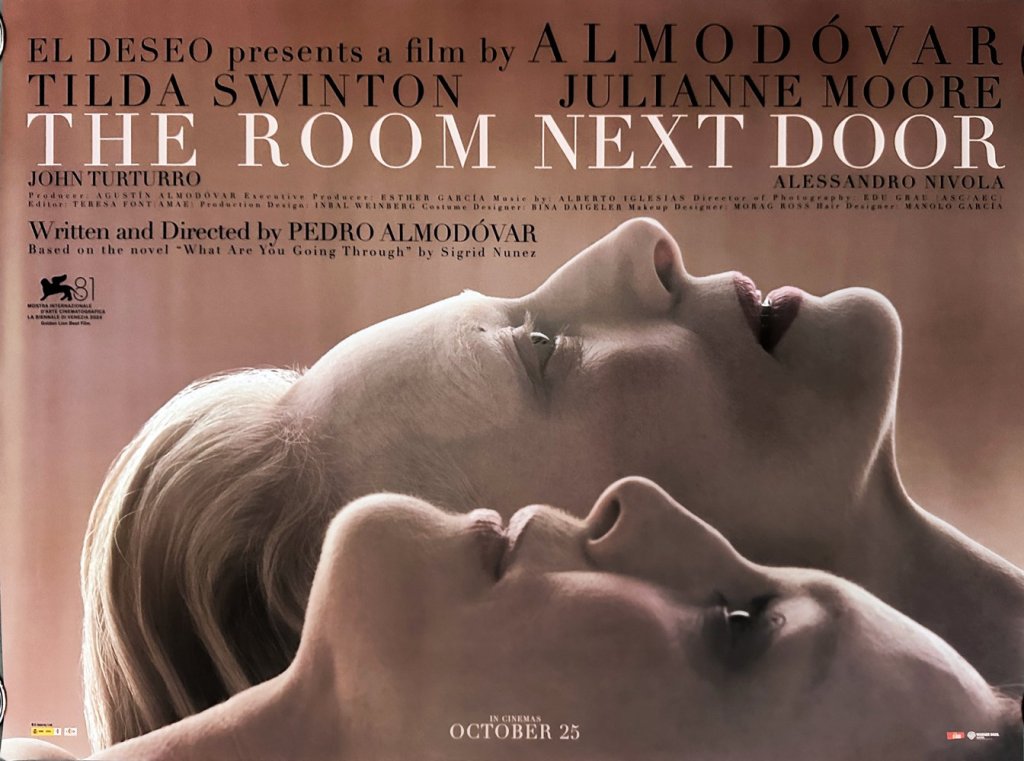
An incredibly sincere film about owning your fate, The Room Next Door follows Martha (Tilda Swinton), a former war reporter who gets the worst news possible: stage‑three cervical cancer that will not get better. Instead of dragging through treatments that drain whatever time she has left, she decides to call the shots herself and asks her long‑estranged friend Ingrid (Julianne Moore) to be there when she takes a final, illegal pill. Spanish master Pedro Almodóvar steps into English for the first time and delivers something intimate, talky, and strangely uplifting, even though death sits front‑and‑center. It premiered at NYFF62 after Venice and it absolutely earns its spot.
What hits first is how frank the movie feels. Almodóvar never coats Martha’s choice in syrupy speeches or slow‑motion tears; instead we get matter‑of‑fact conversations about pain, money, and paperwork, plus sudden bursts of dark humor that remind you these two are real people, not saintly symbols. One minute Martha jokes about hospital coffee tasting like burnt rubber, the next she confesses she is terrified of half‑dying in front of strangers. That whiplash honesty is what keeps the story breathing instead of sinking.

Swinton is phenomenal. She plays Martha like someone who already wrestled with fear off‑screen and has moved on to practicality, though tiny flinches show the fear is still there. It is all in the eyes and the way her shoulders tighten whenever someone says the word hope. Moore matches her with an equally layered turn as Ingrid, a successful writer who thinks she is brave on the page but discovers real‑life courage is messier. Their chemistry—lots of unfinished sentences, old in‑jokes, small flare‑ups—makes the friendship feel lived in from frame one.
Visually the film is almost casual. Most scenes unfold in quiet Airbnbs, hospital rooms, and sunlit cars; colors stay soft until late in the story when a deep orange sunset suddenly floods a living room and you feel time running out fast. Almodóvar’s usual bold palette peeks through just enough to remind us who is behind the camera, but he keeps it restrained so the performances stay front and center. Alberto Iglesias supplies a gentle piano motif that sneaks in, stays a minute, then vanishes again, letting long stretches of silence do the emotional heavy lifting.
The pacing is unhurried and some viewers might call it slow, yet that stillness feels right because the story is about waiting: waiting for treatments to fail, waiting for friends to arrive, waiting for a final sunrise. When tension spikes—like when Martha misplaces the euthanasia pill and panics—it is quick and almost funny before dropping back to stillness. Those little shakes in rhythm keep you alert.

More than anything, the movie nails the complicated idea of agency. It never frames Martha’s decision as the answer for everyone. Instead it shows why she wants control and lets us respect that without turning it into a manifesto. The script even calls out the clichéd language of “fighting” cancer, pointing out how often people equate survival with virtue. Martha refuses that framing completely and seeing her spell it out is oddly thrilling.
Minor quibbles: a few supporting characters feel sketched, and one flashback lands a bit clunky, but honestly none of that matters when the core is this strong. Swinton and Moore give two of the year’s best performances, full stop. Almodóvar proves he can switch languages and still hit the heart, and the ending—quiet, honest, a little messy—left the theater in total silence before the applause kicked in.
Overall The Room Next Door is an earnest, life‑affirming look at death that never begs for tears. It just lays out two friends, one impossible request, and asks what you would do. Easily a top‑tier festival standout and a film that will linger with anyone who watches it.




 Cinema Debate
You must be logged in to post a comment.